
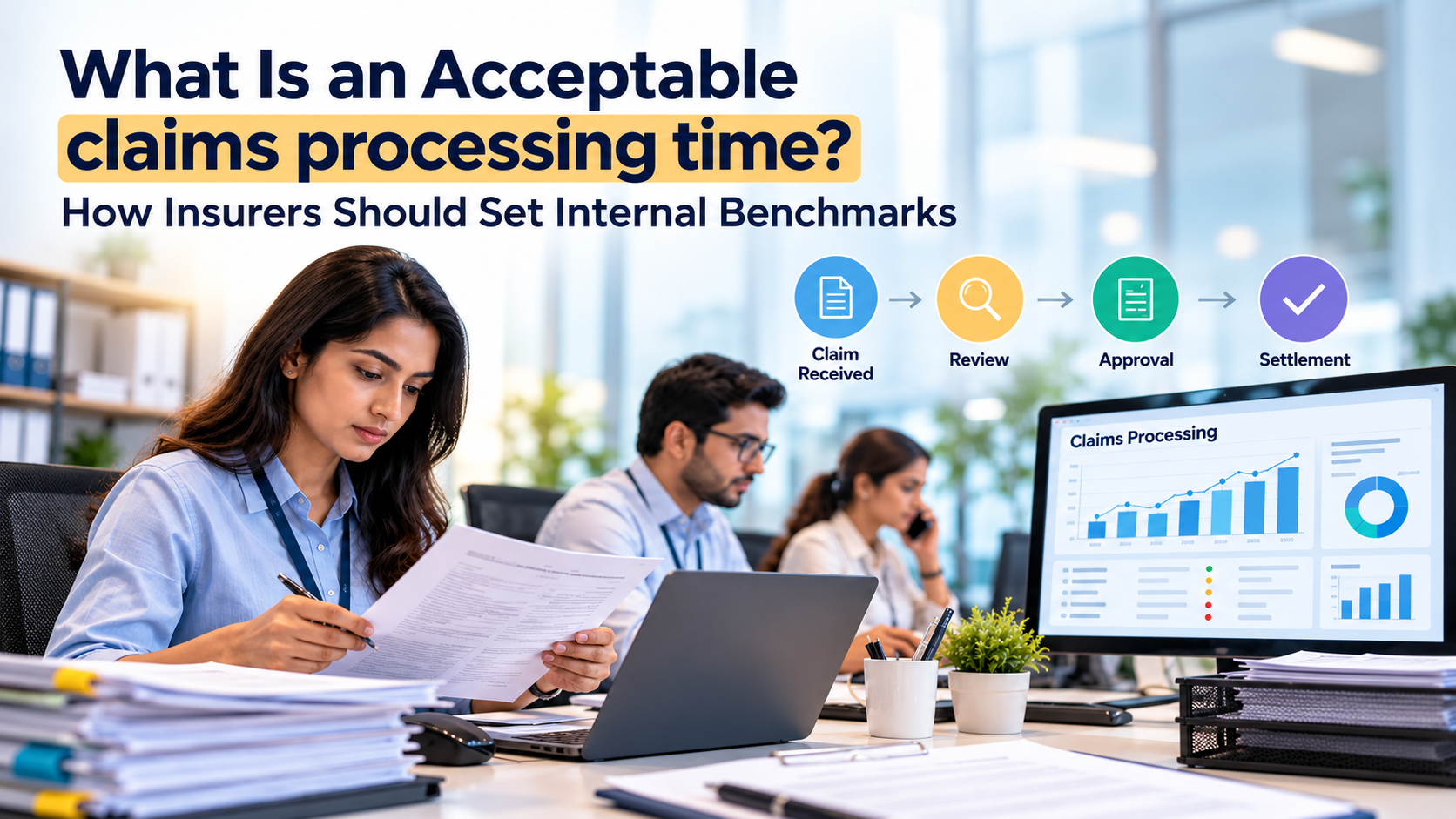
Most claims leaders believe their teams move at a reasonable pace. Policyholders often see it differently. A 2022 survey of 100 senior claims executives at U.S. property and casualty insurers found that 82% said it typically takes more than 30 days to close a physical damage claim.
Slow claim files can be costly for insurers. They lead to customer complaints and may even cause policyholders to switch carriers when renewal comes around. Still, many insurers aren’t sure whether their claims processing time is actually good or needs improvement.
This guide looks at why there’s no standard timeline that works for every insurer, how to set reliable internal benchmarks, and which stages of the claims process tend to cause the longest delays.
Is there one acceptable claims processing time?
No. Not really.
A simple auto glass claim and a contested liability claim share a label. They do not share a timeline. So your claims processing time depends on the line of business, the complexity of the file, and the volume your team handled that month.
Why one industry average misleads
Averages blend very different work. Here is how three common claim types compare.
| Claim type | What drives the timeline | Question to ask |
| Simple auto glass | Photos, vendor scheduling | Did the file close within days? |
| Standard property | Inspection, contractor estimate | Was the inspection booked on time? |
| Complex liability | Legal review, medical records, outside parties | Did the file stall while waiting on others? |
Combining all these claims into one average doesn’t give you a clear picture. Insurance carriers dealing mostly with simple claims may appear faster than those handling complicated cases, even when both teams are doing their jobs well. Looking at claims processing time through a single average can hide these differences.
Catastrophe events can throw the numbers off further. A major hailstorm, for example, can bring in far more claims than usual within a week. Comparing that workload against regular monthly benchmarks can make a capable team look like it’s falling behind. It’s better to track catastrophe-related claims separately.
What U.S. regulators expect
There is no single national standard for claims processing time published by regulators. Instead, they look at unfair claims practices and whether insurers meet basic handling requirements. The NAIC Unfair Claims Settlement Practices Act identifies several unfair practices, including repeated delays that suggest a pattern in how a company handles claims.
The NAIC model regulation covers the minimum requirements for investigating and settling claims. It also counts days as calendar days, not business days. Insurers need to follow the same method when measuring their performance. Using business days in one report and calendar days in another can give them an inaccurate picture of how long claims take.
Claims handling rules differ from state to state. Review the requirements wherever your company writes business and set an internal target that gives you some room beyond the legal minimum. Meeting only the minimum could become a problem during a particularly busy month.
How to set internal benchmarks
Follow these five steps to set realistic targets.
- Start with the past 12 months. Look at closed claims and count the calendar days between the first notice of loss and the final payment or closure.
- Look at each claim type separately. Don’t mix auto, property, liability, and health claims. Keep them in separate groups, and split each group into simple and complex cases.
- See how different handlers and vendors compare. Look at adjusters, teams, branches, and outside partners to see how they handle similar types of claims.
- Set targets based on your actual results. Use the median to see how long most claims typically take and the 90th percentile to spot cases that take longer. Your claims processing time target should be based on improving your own numbers, not simply following industry averages.
- Check progress every month. Don’t change a target until the team has consistently met it for a full quarter.
Measure each stage, not just the total
A total number tells you a file was slow. It does not tell you where the delay started.
| Stage | Question to ask | Common delay source |
| Intake | Was the claim complete on day one? | Missing forms, unclear loss details |
| Triage and assignment | Did the right handler get it quickly? | Misrouted files, complexity mismatch |
| Investigation | Did the file move between requests? | Waiting on third parties |
| Decision | Was a coverage decision made on time? | Rework, unclear authority levels |
| Payment and closure | Did funds go out after settlement? | Administrative lag |
Payment and closure often take the blame for long claims processing time, even when the delay started much earlier. It’s usually at the final stage that the full extent of the delay becomes clear.
What to include in your benchmark report
Keep the report focused on a few useful measures that leaders can review each month.
| Metric | What it tells you | Why it matters |
| Median days to close | The typical file | Shows everyday performance |
| 90th percentile days | The slowest 10% of files | Shows where backlogs hide |
| Stage timing | Where the delay starts | Points to the fix |
| Reopen rate | Files that restart the clock | Reveals premature closures |
| Aged open files | Open claims past target | Warns of next month’s problems |
| Contact gaps | Days without policyholder update | Predicts complaints |
Keep the report simple. A short dashboard that gets read beats a long one that gets ignored.
Where the days usually get lost
A lot of delays start at intake, often more than teams realize. When important details are missing from the initial submission, someone has to follow up before the investigation can begin. That alone can add days to the claims processing time. Late document requests make things worse, and files can easily get overlooked when they move between different systems.
Carriers that want to fix this front-end work often bring in a specialist partner. Teams looking for insurance claims processing support can start by mapping their intake and hand-off steps.
Measure intake first. It sets the pace for every stage after it.
Common mistakes when setting benchmarks
- Copying an industry average or survey figure into your targets
- Starting the clock at different points, such as the call date for some files and the record date for others
- Counting business days in some reports and calendar days in others
- Looking only at average claims processing time and missing the files that take longer
- Leaving reopened claims out of the calculation, even though they can affect the results
- Setting the same processing target for all types of claims
How Techsurance helps
Techsurance works with U.S. insurance carriers and MGAs, helping them manage claims intake, gather documents, and get claim files ready. We follow the guidelines and service levels each client has in place.
We’re not a general call-center staffing provider. We take care of the work that happens during claims processing, especially where delays tend to build up. The aim is to shorten claims processing time without changing how your team makes coverage decisions.
Conclusion
Your past 12 months of data can help you work out a reasonable claims processing time. Use the same method to measure it each month, and check how the results differ across claim types and processing stages. From there, you can set targets to improve on your current performance.
Regulators set the floor. Your internal benchmark should sit above it.
Contact the Techsurance team to plan a claims process review.
FAQs
What is an acceptable claims processing time?
There is no single number. Build your benchmark from your own closed-claim data, split by claim type and complexity.
How is claims processing time calculated?
Count the elapsed calendar days from first notice of loss to payment or closure. Then report the median and the 90th percentile across closed claims.
Is 30 days too long to close a claim?
A 2022 survey found that 82% of senior claims executives said physical damage claims typically take more than 30 days to close. Whether 30 days is too long depends on the claim type and its complexity.
What is the difference between claims processing time and claims cycle time?
The two terms are often used interchangeably. Pick one definition, use it in every report, and track each stage so the total makes sense.
Do regulators set claim deadlines?
Regulators set rules on unfair claims practices, and the specific deadlines vary by state. Check the requirements in every state where you write business.
Should I use an industry average as my target?
No. Averages blend simple and complex claims together. Start with your own baseline, then move targets only after the team has held them for a full quarter.
How often should benchmarks be reviewed?
Review them monthly. Adjust targets slowly, and only after performance has held steady for a quarter.
