
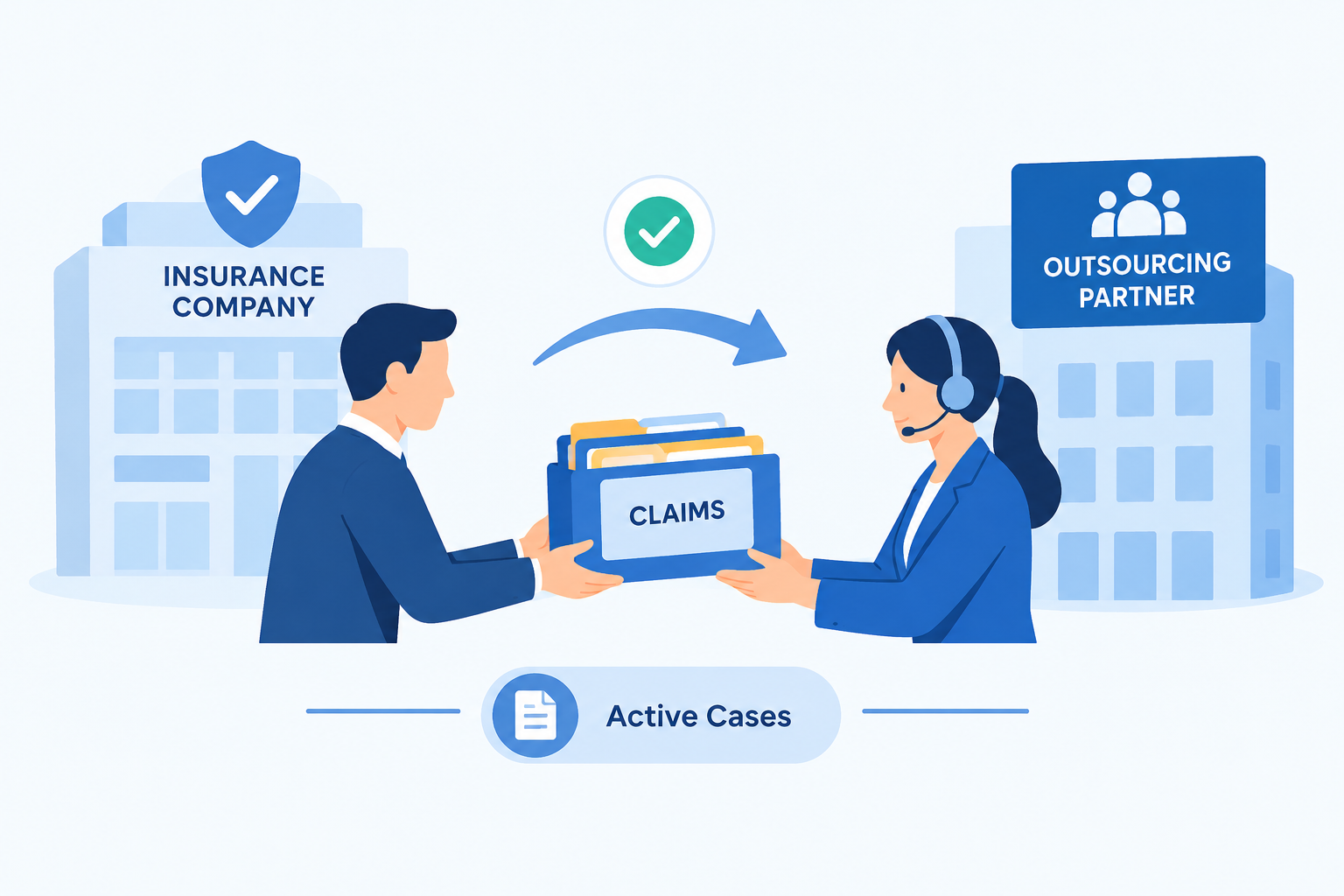
A claims team can start Monday with 140 open files. By Friday, half of them sit with a new partner. Two claimants have already called twice asking why nobody has answered. This is the most common way a transition goes wrong. The new team may be capable. The handoff just wasn’t planned around the cases already in motion.
Insurance claims outsourcing can add capacity, steady turnaround times and specialist review. But the move itself is where carriers and MGAs lose ground. This guide covers how to plan the transition, how to handle files already in progress, and what to measure in the first few months. If you want to see the full range first, explore Techsurance’s insurance KPO services.
What Insurance Claims Outsourcing Covers
Claims outsourcing rarely means handing over the full lifecycle on day one. Most carriers start with a defined slice.
| Claims function | Typically outsourced | Usually kept in-house |
| Claim intake | Logging claims, first data capture, document requests | Coverage decisions |
| Document review | Checking forms and records against your guidelines | Settlement authority |
| Case evaluation | Summaries and checklists for the adjuster | Reserve approval |
| Adjudication support | Eligibility and payout checks | Disputes and exceptions |
| Quality control | Maker-checker review of processed files | Regulatory accountability |
The split depends on your guidelines and risk appetite. Decide it before you sign anything.
Why Transitions Disrupt Active Claims
Each of these problems is manageable. None of them is handled by default.
- Files change hands mid-stream, and the notes stay with the old team.
- The adjuster and the new team read the same policy language differently.
- A claimant’s pending request gets buried in an email chain.
- State response deadlines keep running during the move.
- Fraud signals get missed while new staff learn the book.
Step 1: Inventory Every Open File
Sort open claims into three buckets before anything moves.
- Move now: New claims and straightforward files with no open disputes.
- Move later: Files waiting on third-party documents, medical records or repairs.
- Keep in-house: Litigated claims, large losses, open coverage questions and anything tied to a complaint.
Write one line on each file explaining why it sits in its bucket. That note tells the receiving team what to watch.
Step 2: Map the Workflow Before You Transfer It
Document each step from intake to closure, plus the owner of each step. Include the undocumented steps too. A phone call that updates a reserve is a step. So is the email that tells a body shop to start work.
Then share your guidelines, approval limits, escalation paths and sample files. The partner needs your rules, not only your process map.
Step 3: Run a Pilot Before Live Volume
Pick one low-severity line and a small batch, perhaps 50 to 100 files. Run it with full quality checks on both sides. A pilot shows you where the instructions were unclear. It is much cheaper to find that out on 50 files than on 5,000.
Techsurance works this way too. The team is trained on your process and runs a pilot with full quality checks before it takes on live volume.
Step 4: Agree on Cutover Rules in Writing
Decide when a file changes hands. Options include:
- At intake, for new claims only
- At a specific status, such as “documents received”
- After a clean internal review
Whatever you choose, write the rule down and get sign-off from both teams. Verbal agreements are where files fall through.
Step 5: Hand Off Each File With a One-Page Summary
Every transferred file should carry a short summary:
- Facts of loss and policy details
- Open items and who owes them
- Next action and its deadline
- Claimant contact history and any promises made
- Any reserve or authority limits that apply
Without this, the new adjuster starts from zero and the claimant repeats the story.
A Worked Example: Moving a Stalled Auto Claim
This is an illustrative scenario, not a client case.
A rear-end collision is reported on a Tuesday. The adjuster has requested a repair estimate and a police report. On Wednesday, the file moves to the partner’s queue in the “move later” bucket because the estimate is still outstanding.
The handoff summary lists three items: the date the estimate was requested, the claimant’s preferred contact method, and the rental car authorization limit. The partner’s handler checks the estimate status on Thursday, sends the claimant a status update and logs the call. The carrier’s reviewer samples the file the following week against their own decision.
Nothing gets lost because the summary carries the open items and the deadline. The claimant hears from one team, and the carrier can show a clean audit trail if a regulator asks.
Protecting Deadlines and Claimant Trust
Most states set time limits for acknowledging a claim, investigating it and paying or denying it. Check the rules for every state where you write business. Then build the transition around them.
- Keep one shared deadline calendar that both teams can see.
- Name one owner for claimant contact on every file.
- Agree on how fast an open question must be escalated back to you.
- Use a short, approved script for status calls so claimants hear the same answer from either team.
The National Association of Insurance Commissioners (NAIC) notes that state regulators check claims handling through market conduct reviews, complaint monitoring and data analysis. A poorly run transition can show up in all three. [1]
Compliance Checkpoints for the Transition
The NAIC standards that examiners apply ask whether claims are resolved in a timely manner, handled in line with policy provisions, and documented in the claim file. [2] Build those checks into the transition:
- Every action on a file leaves an audit trail
- Access to claim systems is role-based and reviewed
- Record retention rules are agreed in the contract
- Your compliance team signs off on the partner’s decision rules
- The partner’s staff know which states’ rules apply to each file
For detailed support in this area, see Techsurance’s insurance compliance support page.
KPIs to Track During the Transition
Set targets with your partner during the pilot. Track these from day one.
| KPI | What it tells you | Warning sign |
| Days to first claimant contact | Responsiveness | Spikes after each cutover |
| Files reopened after handoff | Handoff quality | Rising above your baseline |
| Quality audit pass rate | Accuracy of processing | Below your agreed target |
| Files past a state deadline | Compliance exposure | Any increase |
| Complaints tied to transferred files | Customer impact | Upward trend |
Where AI Fits, and What to Ask Partners
Research from ISG, published in October 2026, found that only 8% of buyers of outsourced insurance operations would renew their contracts as they stand. AI was the area where providers most often fell short. [3] The same research found that 75% of respondents would trust an insurance-specific AI model or a governed mix of AI and human oversight for high-stakes underwriting and claims decisions. [3]
The study was commissioned by an AI software vendor, so read the numbers with that in mind. The direction is still useful. Ask partners:
- Where does AI touch a file, and where does a person review it?
- How are AI-driven decisions logged for audit?
- Who is accountable when an automated step goes wrong?
Common Mistakes to Avoid
- Moving the whole book in one wave
- Sending the guidelines once and assuming they are understood
- Skipping the pilot because the partner says its team is ready
- Measuring cost savings and ignoring rework
- Leaving no named owner for escalations
In-House Claims Teams vs. KPO Support
| Factor | Keeping claims in-house | Insurance KPO support |
| Capacity during spikes | Hiring and training take time | Added capacity on agreed terms |
| Domain training | Depends on your internal programs | Teams can be trained for insurance roles |
| Decision authority | Full control | You keep decisions; the partner prepares the work |
| Transition effort | None | Planning, pilot and handoff |
| Quality checks | Internal reviewers | Maker-checker review, if the partner offers it |
Insurance KPO work sits between simple data entry and final decisions. It needs judgment, so the team must understand the policy and the guideline, not just the form. For eligibility and payout checks, see claims adjudication services.
How Techsurance Supports Claims Transitions
If you are considering moving part of your claims book, Techsurance works as an insurance KPO partner. The team handles claim registration, document review, case evaluation and maker-checker quality control, all to your rules. You get regular reports on turnaround, accuracy and quality. Techsurance holds ISO/IEC 27001:2022 and ISO 9001:2015 certifications and GDPR certification.
Learn more about claims processing services or see how the team supports claims administration.
To see how these teams are trained and certified, read why insurers choose Techsurance.
Conclusion
A claims transition does not have to hurt service. Inventory your open files, write the cutover rules down, run a pilot and measure from day one. Carriers that do this keep claimants informed and regulators satisfied while they add capacity.
Planning a claims transition this year? Reach out through the Techsurance contact page or email sa***@*********ce.co to talk through a pilot.
FAQs
What is insurance claims outsourcing?
It is when a carrier, MGA or TPA hands defined parts of the claims process to a specialist partner. The partner’s trained team does the work under agreed checks. The insurer keeps final decisions.
Which claims should move first?
Start with new, low-severity claims that have no open disputes. Keep litigated and large-loss files in-house until the process is proven.
Should open claims move during the transition?
Only in batches, and only with a one-page summary and a clear owner. Files with active disputes or regulator complaints should stay where the experienced handlers are.
How long does a claims transition take?
It depends on book size, line of business and how many states you write in. Plan for a pilot before live volume, and move in stages after it passes.
Does outsourcing transfer our compliance responsibility?
No. The carrier remains accountable for regulatory compliance. The partner executes against your rules, and your compliance team keeps control of regulatory interpretation.
What should we ask a claims outsourcing partner?
Ask how they train staff, how they run quality checks, where AI is used, how they handle data security, which states they work in, and what reports you will receive.
Which KPIs matter most during a transition?
Track days to first claimant contact, files reopened after handoff, quality audit pass rates, files past deadline and complaints tied to transferred files.
