
It is the last week of December. An account manager at a ten-person agency has 41 renewals waiting, three carrier portals open in separate tabs, and a contractor emailing for a certificate by 5 p.m. She is licensed, experienced, and good with clients. She is also spending most of the day retyping policy numbers. (This is an illustrative scenario, not a client case.)
That gap between licensed expertise and clerical load is what insurance agency back office outsourcing is meant to close. An outside team takes defined, repeatable work such as policy processing, endorsements, renewals, and billing records. Your people keep the advice, the carrier relationships, and the final say.
This guide covers the full question for US agencies, MGAs, and the carrier teams that support them. It explains what to hand off, what to keep, how to set the work up, which KPIs to track, and what to ask a provider before you sign.
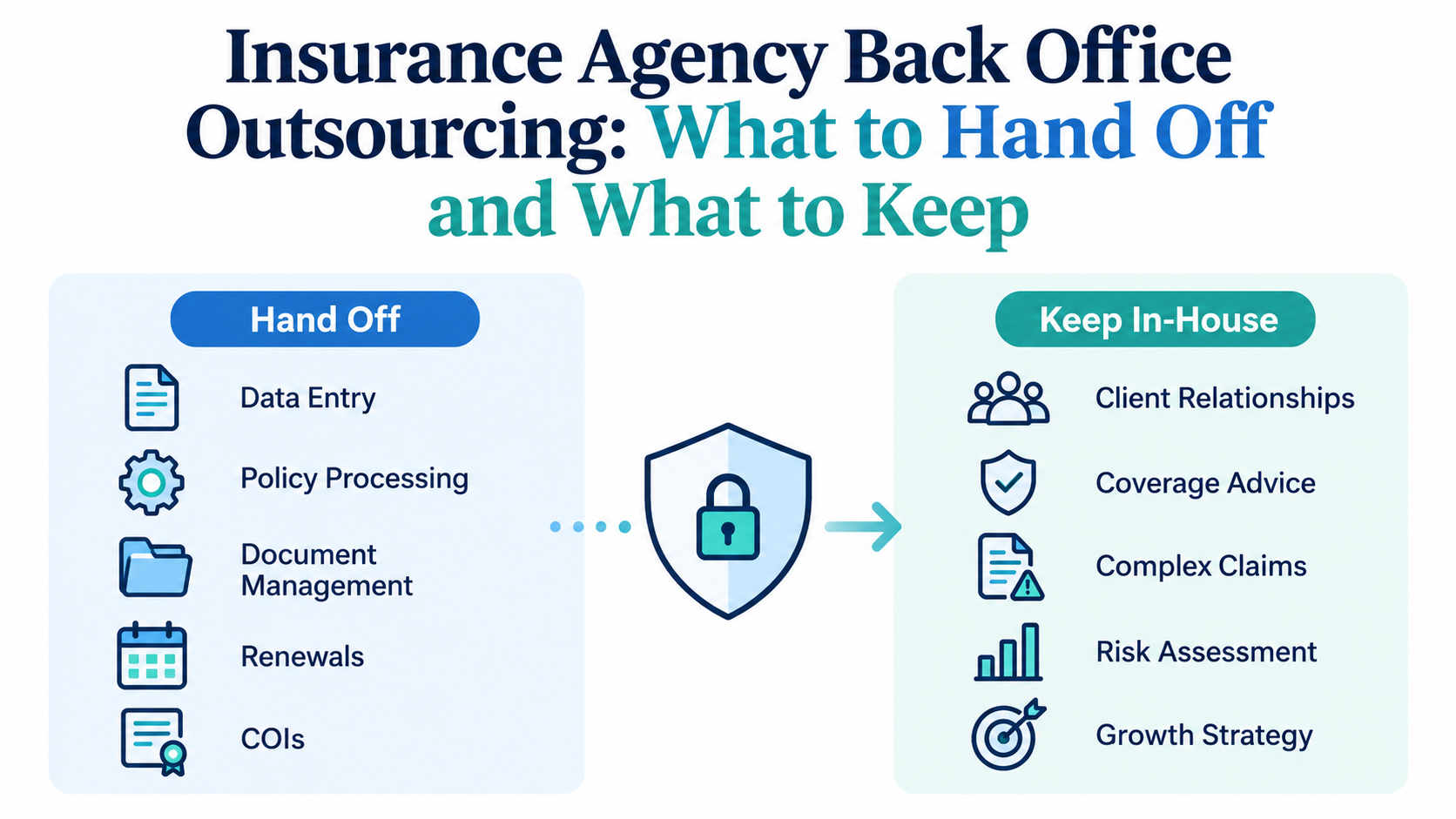
Policy paperwork takes up a lot of an agency’s time. Much of it can be handled by an outside team, especially when the process is already documented. Think policy processing, renewals, endorsements, cancellations, billing records, document indexing, and chasing carriers for updates. The agency still handles coverage advice, negotiations, binding authority, exception approvals, and client relationships.
What is insurance agency back office outsourcing?
Insurance agency back office outsourcing is when an agency assigns certain administrative tasks to an outside team. The work is agreed upon in writing, along with the expected turnaround time and accuracy standards. Someone within the agency reviews and approves what gets done. The outside team may work directly in the agency management system (AMS) or through a controlled workspace. Either way, the agency remains responsible for its client files.
Agencies use different names for this service. You may come across agency back office support or insurance agency outsourcing. The work is largely the same, but how each provider manages it can vary. With some, your staff will need to spend more time checking and managing the work.
Delivery models compared
| Model | How it works | Management load | Best fit |
| Individual assistant | One person is assigned to your agency and takes daily direction from you | High | One steady queue, such as certificate requests |
| Dedicated staff | Named team members work only on your account under your supervision | Medium to high | Agencies with a strong operations manager |
| Managed insurance KPO team | The provider owns the process, quality checks and reporting against agreed service levels | Lower | Several queues, or peak-season volume |
Insurance KPO (knowledge process outsourcing) sits in the third row. A KPO team is trained on insurance rules, so it applies checks instead of copying data. Techsurance works in this model, and its insurance back office outsourcing services are built around it.
Why US agencies are looking at back office outsourcing
The agency channel is changing shape. The Big “I” 2026 Agency Universe Study, as reported by Insurance Journal, counts about 37,000 independent agencies, down from 39,000 in 2024. The average agency now reports 9.9 staff, up from 8.2.
More people has not meant less paperwork. The same study names dealing with multiple carrier interfaces as the biggest technology challenge, as it did in earlier years. Every extra portal adds another place to key in the same data.
Errors show up in the claims data too. IIABA reports that about one-fourth of errors and omissions (E&O) claims involve a renewal. Its list of common alleged errors also includes failing to endorse policies when a client asks for a change. Renewals and endorsements are the work that piles up in a busy month, and an outside team can log, process and track both.
More agencies are turning to automation. According to the study, AI adoption has risen from 15% in 2024 to 46%. Software helps teams get routine work done faster, but someone still needs to deal with exceptions. Techsurance looks at which tasks agencies can automate and which ones need a person to review them.
What can an agency hand off?
Start with tasks that have a written rule, repeat often and leave a record you can check. The table below shows the usual candidates, what the outside team does, what stays with you and the KPI that tells you whether it works.
| Task | What the outside team does | What stays with you | KPI to track |
| Policy processing | Enters new and renewal policy data, indexes documents, checks declarations against the binder or quote | Sign-off on coverage match and exceptions | Data accuracy, turnaround time |
| Endorsement processing | Logs each change request, prepares the carrier submission, applies confirmed changes | Decision on the coverage change, client advice | Request-to-carrier time, error rate |
| Renewal processing | Builds renewal files, chases missing information, tracks carrier quotes | Remarketing decisions, client conversation | Share of renewal files ready by cutoff |
| Cancellations and refunds | Processes notices, prepares return premium figures, updates records | Retention calls, non-standard approvals | Accuracy, aging of open items |
| Billing and commission reconciliation | Matches carrier statements to the AMS and flags mismatches | Write-offs and disputes | Age of unreconciled items |
| Document handling | Indexes, names and attaches files to the right account | Privacy rules and retention policy | Misfile rate |
| Carrier follow-up | Chases pending items and logs status | Escalations to carrier reps | Age of open items |
Policy processing for agencies
Policy processing for agencies covers the steps between a bound policy and a clean file. Someone enters the policy data, indexes the documents and checks that the declarations match what the client bought. Mismatches between the quote, the binder and the issued policy are the most common source of rework.
An outside team adds a second pair of eyes at this point. It compares the documents against a checklist and sends exceptions back to your reviewer with the page and field marked. Your reviewer decides whether the coverage is right. The team confirms the paperwork says what everyone thinks it says.
If your AMS is the real bottleneck, fix the system first. Techsurance’s guide to policy administration systems lists what to evaluate. It is written for carriers, but the questions apply to agencies too.
Endorsement and renewal processing
Endorsement and renewal processing is where agencies lose the most time and carry the most E&O risk. A change request can arrive by email, phone call or text. A renewal can start 90 days out and still land in a queue the week before expiry.
A good outside team treats each request as a ticket. The ticket gets a timestamp, an owner and a status. The steps look like this:
- Log the request with the policy number, change type and requester.
- Check that the request is complete before the clock starts.
- Prepare the carrier submission and send it.
- Track the carrier response and chase if it stalls.
- Apply the confirmed change and update the record.
- Route the client notice to your licensed staff for sending.
Every step leaves a trace. When a client says “I asked you to add that vehicle in March,” you can show who logged the request, when it went to the carrier and when the carrier confirmed.
Billing, reconciliation and carrier follow-up
Commission statements rarely match the AMS on the first pass. An outside team can compare each statement line against the policy record, flag mismatches and keep a list of open items by carrier. Your finance lead decides what to dispute or write off.
Carrier follow-ups work much the same way. The team follows up on pending endorsements, missing documents and renewals that haven’t been confirmed. Every contact is recorded, and your staff only get involved when a carrier representative needs to speak with someone directly.
Service queues
Some agencies also hand off routine service requests such as ID card copies, document requests and status checks. That is a fit for insurance agency outsourcing only when scripts and escalation paths are clear. Any request that turns into coverage advice goes straight back to a licensed person.
What should stay in-house?
Keep anything that needs judgment, a license or a relationship. The table shows the usual list.
| Keep in-house | Reason |
| Coverage advice and recommendations | Licensed activity and the main source of E&O exposure |
| Soliciting and negotiating insurance | Requires a producer license under state law |
| Binding authority and carrier agreements | Tied to your appointments and contracts |
| Approval of exceptions | Needs judgment about your clients and carriers |
| Retention and renewal conversations | Clients expect to hear from you |
| Sample review of outsourced work | You remain accountable for the file |
| Vendor oversight | Your obligation, and in some states a legal one |
Where the licensing line sits
The NAIC Producer Licensing Model Act draws the line between licensed and clerical work. It exempts employees whose activities are executive, administrative, managerial or clerical and only indirectly related to selling, soliciting or negotiating insurance. States adopt their own versions, so check your state before you write the scope. This is general information, not legal advice.
A five-question test for any task
Run each candidate task through these questions. A yes to all five means the task is ready to hand off.
- Is there a written rule for how it gets done?
- Does it repeat at least weekly?
- Can you check the output without redoing the work?
- Can it be separated from advice, negotiation or approval?
- Does a person without a producer license have the right to do it in your state?
A no on question one or two means the process needs work before it moves. A no on question three means you cannot measure quality, so you cannot manage the vendor. A no on four or five keeps the task in-house.
| Result | What it means | Example |
| Green | Hand off now | Indexing documents, billing reconciliation |
| Amber | Document first, then hand off | Renewal file preparation with unwritten carrier quirks |
| Red | Keep in-house | Coverage recommendations, exception approval |
In-house team or outsourced back office?
| Factor | In-house team | Outsourced back office |
| Peak-season capacity | Fixed headcount | Scales with volume under the contract |
| Insurance rule knowledge | Depends on who you hire | Depends on the provider, so ask for evidence |
| Cost structure | Salary, benefits, equipment | Fee tied to volume or team size |
| Management time | Daily supervision | Weekly reviews if the provider runs the process |
| Quality control | Spot checks when time allows | Built-in second-level review if the provider offers it |
| Knowledge risk | Lives in a few heads | Lives in the SOP, which you should own |
Neither option works best for every agency. If a ten-person agency has a stable service team, it may not need an external partner. But if it has to bring in extra staff every January to get through a backlog of renewals, outside support is probably worth considering.
How to outsource your agency back office
Plan the first 60 days around one queue. These steps work for any task in the green column.
- Map the work. Ask each team member to log recurring tasks for two weeks. Note the trigger, the system used and the time spent.
- Start with one task. Renewal file preparation or endorsement logging are good choices since both follow clear rules and are easy to measure.
- Decide what to outsource. Write down the outside team’s responsibilities, where their work stops and who will check it.
- Document the process. Explain what starts the task, what information is needed, what actions are allowed, how to handle exceptions and what confirms the work is complete.
- Limit system access. Give team members access only to the systems they need for their work. Avoid shared logins.
- Test the process first. Have someone check every completed task during the pilot. Once things are running well, switch to reviewing a sample.
- Check performance regularly. Review KPIs every week at first, then monthly. If problems come up, check whether the instructions need fixing before blaming the team.
- Take on more work gradually. Add another task only when the first one can run without someone having to step in every day.
Moving the existing backlog
Transfer the existing backlog with an opening register. List each pending item, its status, its owner and its next action. Without that list, each side assumes the other has the old work.
KPIs and SLAs to set
A service agreement works only when both sides define the same terms. Agree on when the clock starts, what counts as complete and how waiting time is reported.
| KPI | How to define it | Why it matters |
| Turnaround by request type | Clock starts when the request is complete and stops when the carrier submission goes out | Separates processing time from waiting time |
| Accuracy rate | Share of sampled items with no error | Shows quality without checking every file |
| Rework rate | Items returned for correction, tagged by cause | Tells you whether the problem is the SOP or the work |
| Backlog aging | Items older than the agreed number of days | Catches stalled work that averages hide |
| Renewal readiness | Share of renewal files review-ready by your cutoff date | Protects against last-week scrambles |
| Escalation rate | Items sent back to your staff | Shows whether the scope fits reality |
Set targets from your own four-week baseline. Benchmarks vary by line of business, carrier and system, so a number from another agency may not fit yours. Ask for a weekly report that shows new work, completed work, pending work and aging.
Security and compliance checks
The NAIC Insurance Data Security Model Law (#668) asks licensees to oversee their third-party service providers. The model exempts licensees with fewer than 10 employees, and each state that adopted it sets its own terms. With the average agency at 9.9 staff, many agencies sit near that line, so confirm how your state treats you.
What to ask a provider to document
Whatever your size, ask the provider to document these points:
- Which roles can see client data, and how access is approved and removed
- Multi-factor authentication and no shared logins
- Where data is stored and who can reach it
- How soon the provider informs you about a security incident
- Whether any subcontractors have access to your data
- What happens to your data when the contract ends, including how it’s returned or deleted
Certifications are useful, but it’s worth checking what they actually cover. An ISO/IEC 27001:2022 certificate should apply to the company and the systems handling your work. Techsurance explains its approach to compliance reviews on its insurance compliance support page.
What drives cost
Fees follow volume, complexity and the amount of management the provider carries. Compare proposals on the same terms:
- Request types and expected monthly volume
- Working hours and peak-season capacity
- Quality review and reporting included in the fee
- Onboarding and SOP work
- Charges for out-of-scope requests
- Replacement of staff and coverage during absences
- Exit terms and return of records
A low fee that leaves you doing the review and the reporting is not a low cost. Count the internal hours too.
Common mistakes and how to avoid them
| Mistake | What goes wrong | Fix |
| Outsourcing a broken process | The same errors arrive faster | Document and repair the process first |
| Vague scope | Both sides assume the other owns the exception | Write where the work starts and ends |
| Too many queues at once | Nobody can tell what is causing delay | Add one queue at a time |
| No internal owner | Priorities conflict and requests go missing | Name one person who sets priorities |
| Tracking activity, not results | A busy team hides a growing backlog | Report aging and accuracy |
| Weak exit plan | You lose access to your own procedures | Keep SOPs and records in your systems |
| Choosing on price alone | Rework erases the savings | Compare scope, review and reporting |
How to choose a provider
Ask every provider the same questions and compare the answers in writing.
- Which request types will you accept, and which will you refuse?
- Who checks the work before sending it back to us?
- Could you share an example of your weekly report?
- How do you calculate turnaround time, and when does the clock stop?
- What kind of training does your team receive on insurance rules?
- What happens when a request doesn’t fit the standard operating procedure (SOP)?
- Who covers when your assigned person is absent?
- What access do you need, and how do you control it?
- What happens to our data and procedures if we leave?
- Can we speak with a client who uses a similar service?
Offshore delivery and US time zones
Many insurance KPO teams work from India, including Techsurance’s teams in Mumbai and Pune. The time difference helps and hurts. A queue that can wait overnight, such as endorsement logging or reconciliation, is ready for your staff at the start of the US business day. Work that needs a live conversation with your team needs a planned overlap window.
Ask the provider which hours its team covers, how handoffs happen at the end of each shift and who answers urgent requests. A clear handoff note at the end of each shift costs little and prevents most overnight confusion.
Where Techsurance fits
Techsurance is an insurance KPO, and its team works only on insurance. Its published back office services cover new business onboarding, policy administration, and billing and reconciliation. Policy administration includes renewals, cancellations, refunds, endorsements and waiting-period waivers.
Each request is logged, checked against the client’s checklist, processed and reviewed by a second team member (a maker-checker model). It then closes with an audit trail. A quality team samples completed work and retrains on errors, and clients receive regular reports on volumes, turnaround and quality. Techsurance holds ISO/IEC 27001:2022, ISO 9001:2015 and GDPR certification.
Techsurance’s published services are built for carriers, MGAs and TPAs. If your agency or MGA is weighing insurance agency back office outsourcing, a scoping conversation is the fastest way to test fit. Bring your task list and your busiest month. If underwriting support also sits in your queue, the underwriting service page covers that side.
You can contact the Techsurance team to map which tasks suit back office outsourcing for your volumes and rules.
Conclusion
Good insurance agency back office outsourcing starts with a clear line. Hand off the work that follows written rules and leaves a record. Keep the advice, the authority and the client relationship. Start with one queue, set KPIs from your own baseline and keep an internal owner who reviews the results.
An agency that follows those steps ends up with fewer retyped policy numbers and a renewal queue that is ready before the last week of the month.
FAQs
What is insurance agency back office outsourcing?
It is the practice of moving defined administrative work, such as policy processing, endorsements, renewals and billing records, to an outside team under a written scope and service levels. Your agency keeps advice, approvals and client relationships.
What back office tasks can an insurance agency outsource?
Insurance agencies often outsource policy data entry, document indexing, endorsements, renewals, cancellations, refunds, commission reconciliation, and carrier follow-ups. Each task should have clear written instructions and a way to check that the work was done correctly.
What should an agency never outsource?
Some decisions need to stay with your licensed staff. These include coverage advice, soliciting, negotiating, binding authority, and approving exceptions. Since each state has its own licensing rules, it’s worth checking those before you work out what the outside team can handle.
How do I know if my agency is ready to outsource?
Think about what would happen if someone new had to take over a task tomorrow. Would they have clear instructions to follow? You should also have someone available to manage the provider and a reliable way to check the results. If the work relies mainly on what your employees remember, document the process before you outsource it.
Is outsourced back office work secure?
It can be, but don’t assume every provider handles security the same way. Ask who gets access to your systems, whether they use multi-factor authentication, and how quickly they’ll tell you if something goes wrong. Find out how they’ll return or delete your data if you leave. You’ll also want to check the actual scope of their security certificates and the NAIC data security requirements that apply in your state.
How long does it take to start?
The timeline depends on scope and how well your processes are documented. A single-queue pilot is the quickest way to start, and most of the effort goes into the scope, the SOP and system access.
