
A submission for a commercial property arrives at an underwriter’s desk together with a loss control inspection. The report is detailed, though it also contains eleven pages of unstructured notes, photographs, and a hazard score which is located on page nine. The underwriter has forty other files waiting to be dealt with and only fifteen minutes in which to phone about this one.
The difference between what loss control provides and what underwriting is actually able to use within the time available is the source of much of the loss in pricing accuracy. This is entirely unrelated to the quality of the inspection; it is a workflow issue and is reflected in renewal decisions, declinature rates, and the combined ratio each quarter.
The article explains the actual relationship between loss control in insurance sector and underwriting decisions, the point at which that relationship usually breaks down, and what insurance companies and MGAs should look for when assessing the support for the handover.
What Is Loss Control in Insurance?
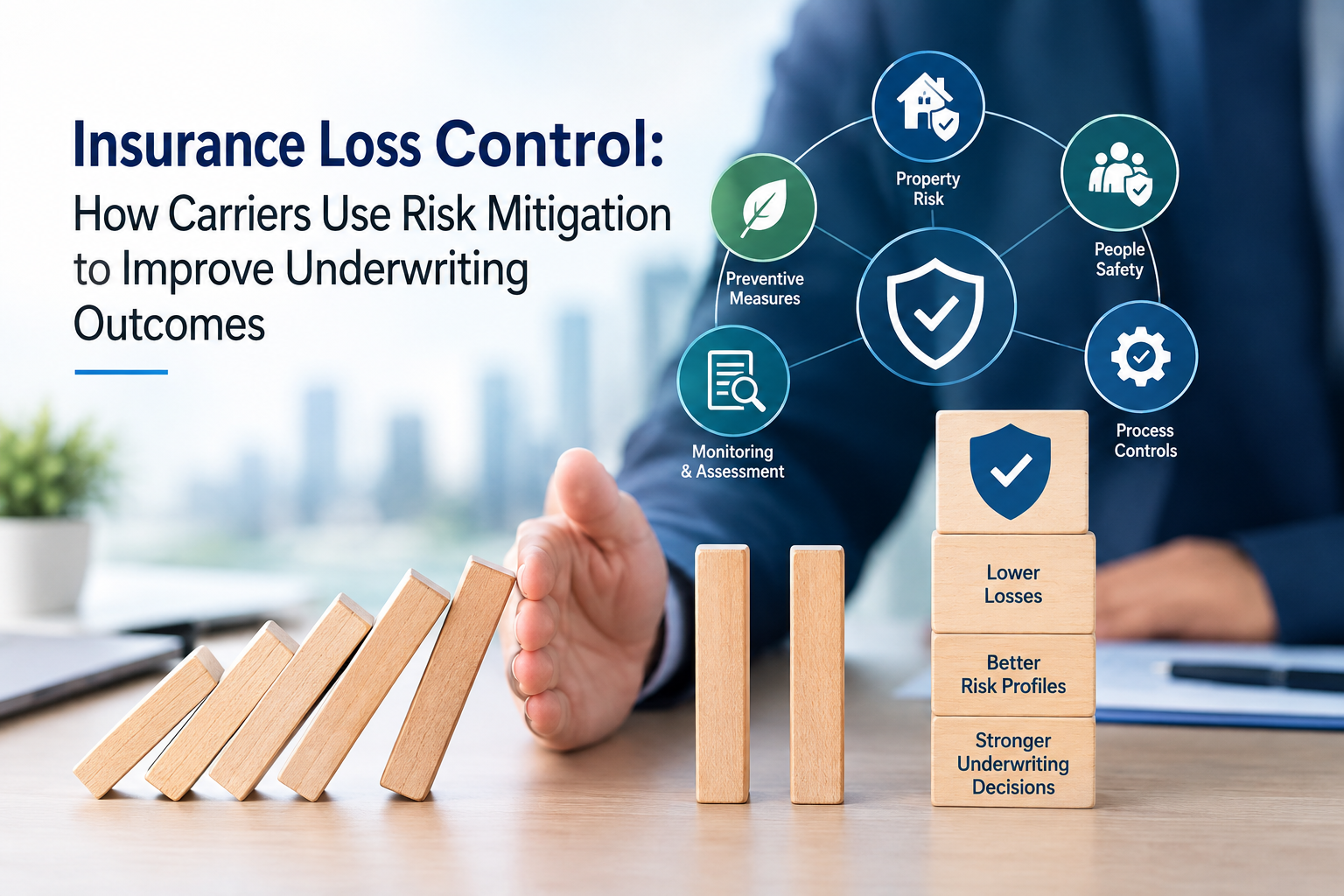
Loss control consists of the various activities carried out by an insurer or its risk services department in order to identify, assess, and reduce the hazards which result in claims. These activities include conducting physical inspections, providing safety advice, carrying out hazard scoring, and making follow-up recommendations relating to a particular policy or account.
It complements insurance risk assessment, but the two are not the same. Risk assessment takes place earlier, at the time of submission, in order to determine whether or how to price the risk. Loss control, on the other hand, usually goes on after the policy has been issued to verify that the insured is actually managing the hazards which the underwriter originally priced.
For companies that provide commercial property, general liability, or workers’ compensation insurance, loss control insurance services are one of the only underwriting inputs that are based on a physical examination of the actual exposure rather than just the information given in the application. That is the reason why the data has to get to the underwriting department in a form that is usable. If the results of a field inspection are left in a PDF and no one reformats it before the renewal date, then the inspection amounts to nothing.
How Loss Control Fits Into the Underwriting Process
A loss control inspection never takes place by itself; it is one stage in a series that begins with a submission and ends with a binding, declining, or renewing decision.
The Referral Trigger
Most loss control referrals are automatically issued, the decision being based on the size of the premium, the occupancy class, or the client’s past loss record. For instance, a new submission for a warehouse that exceeds a certain threshold value of insurance (TIV) will generally result in a property inspection before the underwriter can finalise the terms.
Inspection and Data Collection
A field inspector or risk consultant goes to the site, records the hazards, takes photographs of the conditions, and assesses the level of risk using a standard checklist. This stage provides the original data for all the subsequent steps.
Findings Review and Underwriter Handoff
The report is examined, checked to make sure it is complete, and then summarised for the underwriter. It is at this stage that quality control is most important; if a report is found to be incomplete or inconsistent and is still sent back to underwriting without being checked again, this results in rework, and it is rework that causes the submission-to-bind deadlines to go beyond what both brokers and insureds expect.
Types of Loss Control Services Carriers Use
The way a loss control engagement is carried out varies depending on the type of insurance business; a visit carried out in the case of workers’ compensation is very different from a general liability review.
| Line of Business | Typical Loss Control Focus | Common Findings |
| Commercial Property | Fire protection systems, building condition, occupancy hazards | Sprinkler deficiencies, electrical issues, roof condition |
| General Liability | Premises safety, product handling, contractual exposure | Slip and fall hazards, inadequate signage, subcontractor risk |
| Workers’ Compensation | Employee safety programs, machine guarding, ergonomics | Missing safety protocols, training gaps, repeat injury patterns |
Property Loss Control
Property inspections look at the physical structure of the building and its various systems, such as the sprinklers, alarms, wiring, and the age of the roof; the results of these inspections have a direct impact on the price of the property and can decide whether a insurer needs certain improvements carried out before agreeing to the policy.
General Liability and Casualty Loss Control
When loss control takes a casual approach it examines the way in which the insured carries out their daily activities. Since retail outlets, contractors, and manufacturers have different types of premises and product exposures a one-size-fits-all checklist cannot take account of this.
Workers’ Compensation Loss Control
Loss control in workers’ compensation places great emphasis on reviewing the safety program. When a consultant looks at the records relating to machine guarding and training, they are seeking the same thing that an underwriter is concerned about – whether or not the insured’s claims frequency is likely to remain in line with the amount that has been charged.
How Risk Mitigation Data Changes Underwriting Outcomes
The risk mitigation insurance data is included in the file when it affects the actual actions of the underwriter, and that occurs in a number of particular ways.
- A hazard finding has the potential to increase or decrease prices, even when considered on its own apart from the application data.
- Even if an account is generally appealing, serious hazards that are not dealt with could result in declination or restrictions on coverage.
- Recommendations that are linked to a timeline for instance, the installation of a sprinkler system within 90 days become policy conditions and are then monitored at renewal.
- A favourable or improving record in loss control leads to more favourable renewal terms, since this is one of the rare underwriting results which an insured can directly affect by means of their own risk management.
Nothing of the sort occurs automatically; it is necessary for the findings to reach the underwriting department in a format that allows the underwriter to take action before the deadline, not after it. The difference between a report that leads to a change in decision and one that is merely filed is that a risk assessment services function is used to verify and organize the data before it enters the underwriting queue.
Common Bottlenecks Between Loss Control and Underwriting
The main difficulty in this process does not lie in the quality of the inspection. It lies in the events that take place between the field visit and the underwriter’s examination.
Inconsistent Report Formats
Different inspectors, vendors, or regions generally use different report formats and calculate their hazard scores in different ways. Therefore, when an underwriter is comparing two submissions they cannot easily determine if a ‘moderate’ rating has the same meaning in both cases.
Turnaround Delays
Forcing a decision on a renewal which has a two-week deadline, a loss control report takes three weeks to get to underwriting.
Disconnected Systems
The findings of the loss control department are usually in a different system from the underwriting one, so they have to be re-entered by hand or a summary email has to be sent, this process causing a loss of details.
All of these problems can be solved, but it isn’t possible by getting the underwriters to work more quickly; what is needed is a dedicated processing layer which will standardize, validate, and route the loss control data before it becomes the underwriters’ issue.
In-House Loss Control Processing vs. Outsourced Support
| Factor | In-House Processing | Outsourced Loss Control Support |
| Staffing flexibility | Fixed to internal headcount | Scales with submission volume |
| Report standardization | Varies by team and region | Consistent templates and scoring |
| Turnaround during peak volume | Often slows during renewal season | Maintained through added capacity |
| Underwriting integration | Depends on internal handoff process | Built around underwriter-ready summaries |
| Cost structure | Fixed overhead year-round | Variable, tied to actual volume |
It is not the case that either model is suitable for every carrier. A smaller MGA with a steady and predictable volume of business could probably look after its loss control processing on its own without any strain. On the other hand, a carrier that experiences seasonal peaks or has a number of lines of business usually finds that its in-house teams are overloaded precisely when underwriting requires the data most.
What Underwriting Teams Should Evaluate in a Loss control Partner
Before adding outside support for loss control processing, insurance operations teams should get clear answers on a short list of questions:
- What procedure is followed to check that the data is of a good quality before it is given to an underwriter?
- What is the average time that elapses between inspection and the production of the underwriter-ready summary?
- Will the partner be able to scale up during the renewal season without experiencing a drop in accuracy?
- In what way does the workflow combine with the carrier’s current underwriting and policy systems?
- What compliance and documentation standards are applicable to the process?
That particular point is more important than it may at first appear. Since loss control findings are frequently included in the underwriting file which is then used to justify a rating decision at a later stage, the process must be able to stand up to audit scrutiny, not just be quick to carry out. When insurance companies assess the compliance support in connection with the loss control process, they are able to identify this gap earlier than those who regard the two aspects as separate.
How Techsurance Supports Loss Control-to-Underwriting Workflows
For the operational aspect of underwriting, Techsurance works with US carriers and MGAs, covering the data processing that takes place between the loss control findings and the underwriting decision itself. This involves checking that inspection reports are complete, ensuring that hazard summaries are standardized among inspectors and across different lines of business, and making sure that underwriter-ready findings are routed within the turnaround windows that the renewal cycles actually require.
It does not take the place of the expertise gained from field inspections. Rather, it functions as a processing stage to ensure that the work carried out by a loss control inspector reaches the underwriting department in a format that can influence the decision, rather than arriving too late or in a disorganized state to be of any use. The same quality-control approach that Techsurance uses in its own case work to detect inconsistencies in underwriting documentation is applied here: identifying what a quick manual review would have overlooked before it gets to the underwriter’s decision.
Conclusion
Loss control only enhances underwriting results when its findings are passed on to the underwriter in a useful, timely, and standardized manner. The inspection is seldom the problem. The handoff is.
The commercial lines combined ratios are expected to become slightly tighter in 2026, with AM Best forecasting an increase to 96.3 from 95.8 the year before, and general liability continuing to be one of the few lines still operating above breakeven. Given the narrow margin for error in the market, the data used to make a pricing or renewal decision must be available faster than the deadline it is intended to address.
People who are involved in carriage or who act as MGAs and who want to narrow the gap without having to increase their permanent staffing can obtain underwriting support that has been designed specifically to handle loss control and risk data at the volume and speed required during the renewal season.
FAQs
What does loss control mean in the context of insurance?
Loss control involves identifying, assessing, and reducing the hazards associated with an insured risk, typically by means of inspections, providing safety advice, and making follow-up recommendations which in turn influence underwriting and renewal decisions.
What is the difference between loss control and risk management?
Risk management represents the wider strategy that the insured uses for dealing with the risks in their operations, while loss control is a more limited function which is driven by the insurer and concerns specific hazards associated with a policy, usually carried out by means of inspections and scoring.
How does a loss control inspection work?
A field inspector or risk consultant goes to the place where the insurance policy holds, records the hazards, takes photographs, and rates the risk using a standard checklist; the results are subsequently examined and compiled for the purpose of underwriting.
How does loss control data affect underwriting decisions?
Findings can shift pricing, trigger coverage conditions, support declinature on high-hazard accounts, or strengthen renewal terms when hazards have been addressed since the last inspection.
Who conducts loss control surveys for insurance carriers?
Surveys are typically conducted by in-house loss control engineers, third-party inspection vendors, or specialized risk services firms contracted by the carrier or MGA.
Can loss control findings affect a policy renewal?
Yes. Unresolved hazards flagged in a prior inspection, or conditions attached to the original bind, are commonly reviewed again at renewal and can affect pricing or terms.
How can insurers speed up the loss control-to-underwriting handoff?
Standardizing report formats, adding dedicated processing capacity for peak renewal periods, and integrating loss control data directly into the underwriting workflow are the three levers that most reduce turnaround delays.
