
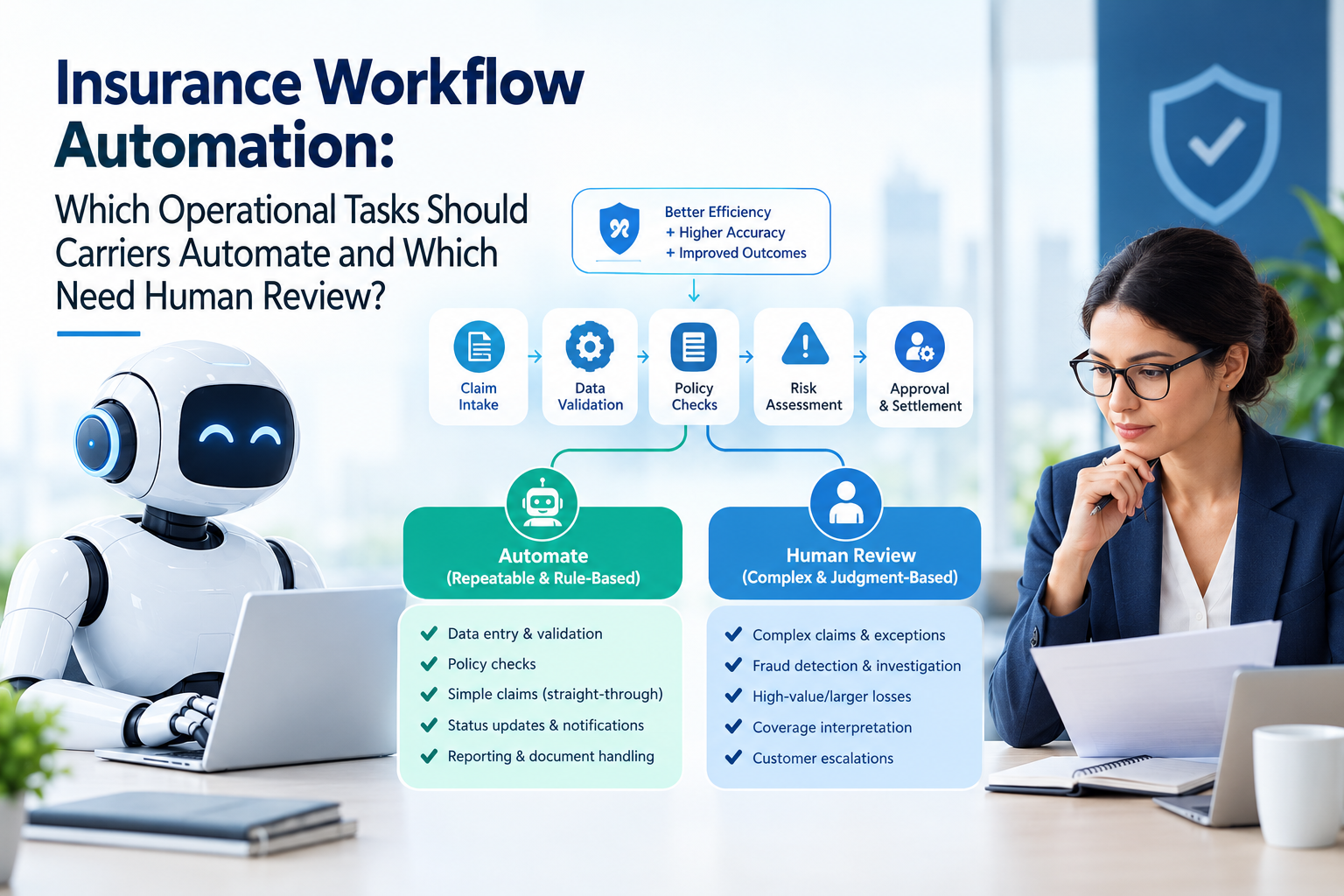
The company automated both the process of taking in claims and the step of assessing those claims, since the vendor’s demonstration suggested a single, uninterrupted pipeline. Three months later, a group of claims containing unusual liability wording was automatically approved at a payment level no one would have agreed to if a person had made the decision manually. The automation functioned precisely as it had been constructed. The issue was whether it should have been included in the first place.
The genuine issue concerning insurance workflow automation is not whether or not to automate since most carriers have already done so, but rather which particular tasks can be delegated to a system and which still require a person to make the call.
The article analyzes the decision by task rather than department and gives underwriting and claims operations managers a framework they can apply to their own workflows.
What Is Insurance Workflow Automation?
Insurance workflow automation involves the use of software, rules engines, or robotic process automation to carry out repeatable operational tasks in the areas of underwriting, claims, and policy administration without having manual intervention at each step.
It includes a broad spectrum of maturity levels; at one extreme simple rule-based automation directs a document to the appropriate queue, while at the other end AI-powered systems carry out an actual underwriting or claims decision within certain parameters. Since the term is used so loosely, for one insurer ‘automation’ may mean a macro that fills in a form, whereas for another it means a completely automated bind decision.
According to Deloitte’s 2024 industry survey, 76% of insurance companies in the US had already introduced generative AI into at least one of their business functions, claims processing being one of the main applications. The issue now is not whether it has been adopted but where to draw the line between work that is automated and that which is reviewed by a human.
How to Decide What to Automate
The extent to which a task is suitable for automation depends on three factors: how much of it there is, how repeatable it is, and the cost of making an erroneous automated decision.
- Volume: The amount of work involved is enough to justify the cost of setting up automation if the task is carried out thousands of times each month; if it only occurs a dozen times a year, it usually isn’t.
- Repeatability: Repeatability means that tasks which have only a limited number of definite inputs and outputs, such as a standard endorsement request or a routine document upload, can be automated effectively, whereas those which involve assessing context do not automate well.
- Decision risk: The risk of making a decision is the aspect that most carriers give too little attention to. If an automated decision is wrong when it comes to data entry, it results in the need for a correction. If an automated decision is wrong in the case of a coverage determination or a fraud flag, it leads to a claim, a regulatory inquiry, or a damaged client relationship.
If you carry out any candidate task using all three criteria, a task which scores highly in terms of volume and repeatability but involves serious decision risk should still be assigned to a human, at least when it comes to exceptional cases.
Insurance Operations Tasks Well Suited to Automation
There are some tasks which fully satisfy all three criteria and which are already being automated by the various carriers without any significant disadvantages.
Document Intake and Data Entry
Getting data from a submission form, an application, or a loss report into the right fields is a high-volume, highly repetitive task which carries low risk if any corrections need to be made later on, so it is the area in which most of the budget for insurance process automation is first allocated and for good reason.
Policy Issuance and Endorsements
The rules for carrying out standard endorsements, changing addresses, and making plain policy issuances are fixed. Automating this process removes the need for underwriters to carry out clerical tasks without in any way affecting the actual coverage decision.
Claims Automation for Low-Complexity Claims
Insurance claims automation works well in cases where there is clear liability, the amounts involved are low, and the documentation is standardized, for example in the case of a broken windscreen or a minor fender bender for which a police report has been accepted. According to McKinsey’s research into insurance automation, the theoretical upper limit is about 45% of the current work activities in the industry, and simple claims are close to the top of what is currently realistic.
Where Underwriting Automation Works, and Where It Doesn’t
Underwriting automation is where the automate-versus-review line gets blurry, because underwriting itself spans a huge range of decision complexity.
Automated Underwriting for Standard Risks
A policy which is small in size, has a clean record when it comes to losses, belongs to a standard occupancy category, and involves no unusual coverage requests is a suitable one for automated underwriting since the rules in this case are well established, the volume is large, and the risk of making a few mistakes is acceptable.
Why Complex or Borderline Risks Still Need a Human Underwriter
An algorithm is incapable of exercising judgment in cases where there are previous losses, an atypical level of exposure, or coverage terms that differ from the standard template. Although automated underwriting systems perform well at pattern matching, they struggle with genuinely ambiguous risks since ambiguity is precisely the kind of situation that pattern matching cannot deal with.
Insurance Tasks That Should Stay With Human Review
The level of decision risk involved in some tasks is so great that automation should not make the final decision, even if the actual data processing has been automated.
Adverse Findings and Declination Decisions
To decline a risk or to report an adverse loss control or credit finding has important legal and reputational implications. Before the decision is issued, a person must look at the specific reasons rather than simply approving the summary provided by the system.
Fraud Indicators and Escalations
Automated fraud scoring is useful for identifying patterns, but a trained analyst is required to decide what to do with a flagged claim such as whether to investigate it, deny it or pay it taking into account information that the scoring model cannot see.
Compliance-Sensitive Documentation
Any item that is included in a regulatory filing or in a defence file during a dispute must have a documented stage at which a human carries out a review, even if the draft has been prepared by automation.
Robotic Process Automation vs. Human-in-the-Loop Review
| Factor | Robotic Process Automation (RPA) | Human-in-the-Loop Review |
| Best suited for | High-volume, rules-based tasks | Judgment calls, exceptions, adverse decisions |
| Speed | Immediate, no queue time | Slower, bound by staff capacity |
| Error pattern | Consistent, repeats the same mistake at scale if the rule is wrong | Inconsistent between reviewers, but catches context a rule misses |
| Cost driver | Setup and maintenance of rules | Staffing and training |
| Where it fails | Ambiguous or novel situations outside the rule set | High volume, routine tasks that don’t need judgment |
The two are not competing methods; instead, robotic process automation insurance works most effectively when it takes care of the routine 80 percent of a workflow and has the other 20 percent forwarded to a human rather than attempting to cover the whole process end to end.
What Happens When Carriers Automate the Wrong Tasks
The way in which failure occurs is the same in all companies that have made this mistake: automation is extended one step beyond the point at which it should end, typically because the neighboring task appears similar on the surface.
The claims team automates the intake process and then applies the same approach to the adjudication of claims that at first sight seem routine but aren’t. Similarly, the underwriting team automates pricing for standard-risk cases and then has the same system handle submissions involving unusual terms since ‘it’s mostly the same process’. In each instance, the criteria of volume and repeatability are satisfied. However, the aspect relating to decision risk is neglected, and that was the important one.
Watch for a few warning signs before extending automation further:
- Exception rates climbing without anyone reviewing why
- Complaints or disputes tied to a specific automated workflow
- Staff routing around the automated process because they don’t trust its output
If any of these apply, then the task should be taken back for review rather than being pushed further.
Building a Human-in-the-Loop Insurance Automation Model
It is not the carriers who have automated the largest number of tasks that are deriving the most benefit from insurance workflow automation; rather, it is those who have established a clear and documented distinction between the decision made by a system and the one confirmed by a person, together with a functioning feedback loop between the two.
The model involves continuous operational management, which includes someone keeping an eye on exception rates, retuning the rules as the risk profiles change, and ensuring that the staff responsible for human review remains staffed and trained to handle the actual volume of cases they receive. This kind of operational support prevents an automation program from moving beyond its safe limits as the volume increases, without it being necessary for the carrier to set up that monitoring function themselves.
Conclusion
Insurance workflow automation is most effective when used as a focused tool rather than as a general approach. Those tasks which involve a high volume, have clear rules, and carry little decision risk are suitable for automation at the present time. However, tasks that involve adverse decisions, fraud, or compliance exposure still require a human to review the output, no matter how confident the system is.
Getting the split correct and maintaining that correctness as the volume and risk profiles change is an ongoing operational responsibility. When insurers are setting up or improving that balance, they can obtain underwriting support that is designed to assist with and control the human review stage that a responsible automation program still requires.
FAQs
What is insurance workflow automation?
The application of software, rules engines, or AI to carry out repetitive tasks in the areas of underwriting, claims, and policy administration without requiring manual intervention at any stage, whether it be the simple routing of documents or automated decision-making within set limits.
Which insurance operations tasks are easiest to automate?
The tasks that are easiest and carry the lowest risk to automate include document intake, data entry, standard policy endorsements, and claims of low complexity with clear liability.
Why can’t underwriting be fully automated?
Risks that are standard and of low complexity can be handled by automation, but in the case of submissions involving unusual exposures, previous losses, or nonstandard terms a human underwriter’s judgment is required since a rules-based or pattern-matching system cannot reproduce it.
What is robotic process automation in insurance?
RPA, which is known as robotic process automation, involves the use of software bots to carry out repetitive and rules-based tasks such as data entry and document processing, generally as part of a broader workflow that still includes human inspection for exceptions.
What happens when an automated decision is wrong?
The consequences depend on the task. A data-entry error is a quick fix. A wrong automated decision on underwriting or claims can lead to mispriced risk, a denied claim that should have been paid, or a compliance issue, which is why higher-risk decisions need a documented human check.
How do carriers combine automation with human review?
By automating the high-volume, low-risk portion of a workflow and routing exceptions, adverse findings, and ambiguous cases to a trained reviewer, with a feedback loop that adjusts the automation rules based on what the exceptions reveal.
What is straight-through processing in insurance?
In insurance, straight-through processing refers to handling transactions from start to finish through an automated workflow, without human involvement at each step. It is typically applied to simple policies or claims where the process is predictable and the risk level is low.
