
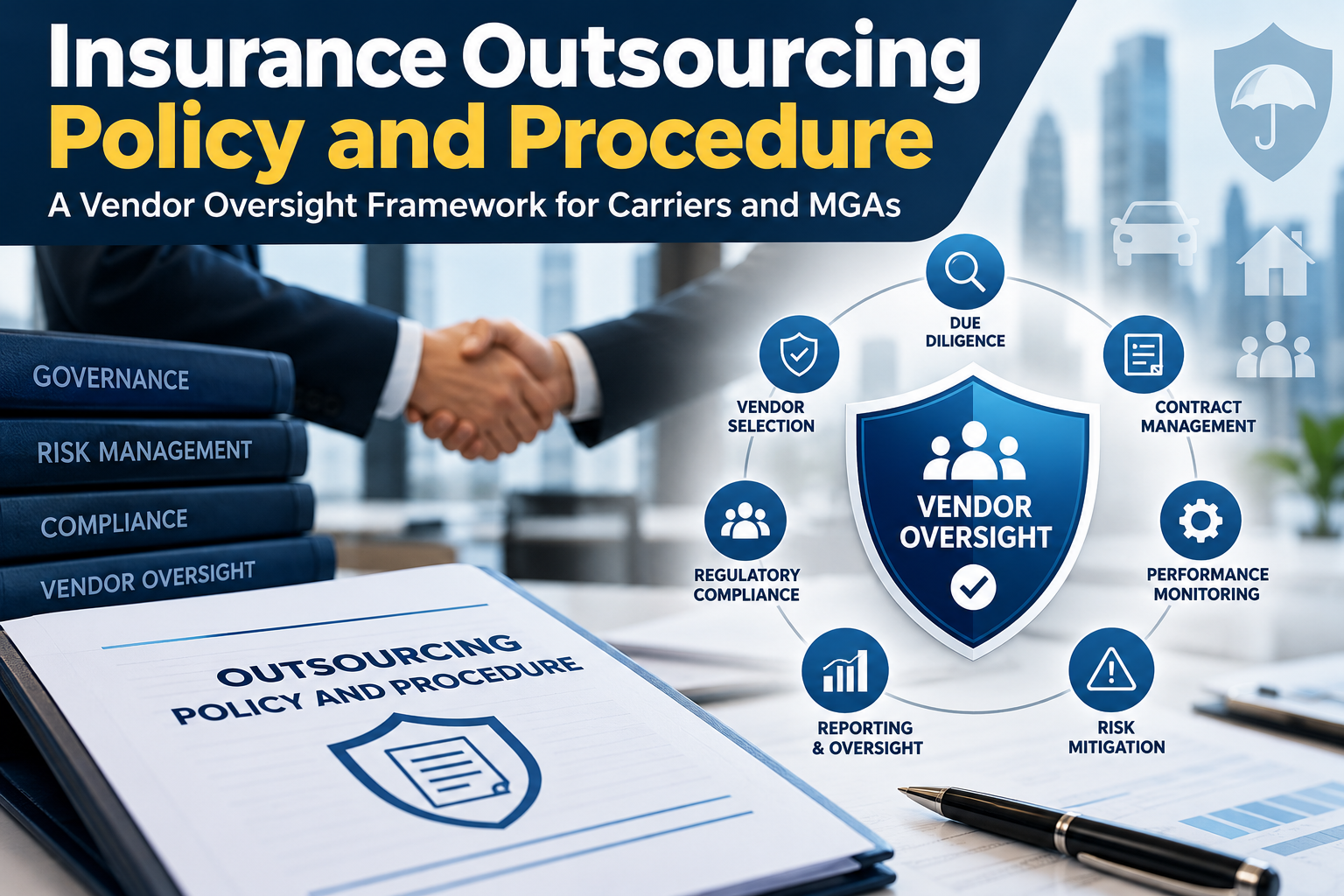
During a market conduct examination, a regulator may ask who approved the outside firm handling your claim files and where that approval is recorded. If all you have is an email exchange and a signed statement of work, that question is hard to answer.
A clear outsourcing policy and procedure solves this problem. It sets the approval requirements, assigns responsibility, and creates a process that continues even when the people involved leave the company.
This guide covers what an outsourcing policy should include, how it differs from the procedures used to carry it out, and how US carriers and MGAs can manage vendor oversight day to day while staying ready for regulatory review.
What Is an Outsourcing Policy and Procedure?
An outsourcing policy lays out the company’s approved rules for outsourcing work. It explains which tasks outside vendors can handle, which must remain in-house, who has authority to approve outsourcing, and what standards vendors must meet.
The procedure covers how things are done in practice. It runs from evaluating vendors and drafting contracts through onboarding, tracking performance, and ending an arrangement when necessary.
Both are needed. The policy provides clear boundaries, and the procedure helps employees follow them. Without a procedure, the policy may never be put into practice. Without a policy, the process changes depending on who is managing it.
Why Carriers and MGAs Cannot Treat Vendor Oversight as Optional
Handing work to a vendor does not hand over responsibility. The NAIC’s model bulletin on AI, adopted in December 2023, makes insurers accountable for managing third-party vendors.
The bulletin is guidance until a state adopts it, so check your home state and every state where you write business. The model applies only to the extent that a state adopts it. Even so, the direction is clear. Insurers should implement contract terms that allow audit rights and require cooperation with regulatory inquiries when appropriate.
Regulators look for a written outsourcing policy and procedure because it gives them one document to test your practice against. The NAIC adopted its Insurance Data Security Model Law in 2017. That model law includes oversight of third-party service providers among its requirements.
Policy vs. Procedure at a Glance
| Factor | Outsourcing policy | Outsourcing procedure |
| Purpose | States the rules and limits | Describes the steps and checkpoints |
| Owner | Board or risk committee | Vendor management, operations, compliance |
| Changes | Reviewed yearly or after major events | Updated when workflows or systems change |
| Typical content | Prohibited functions, approval thresholds, minimum controls | Due diligence questionnaire, onboarding checklist, QC sampling plan |
| Main reader | Executives, auditors, regulators | Staff, vendor managers, team leads |
Who Owns Each Part
| Role | Responsibility |
| Board or risk committee | Approves the policy and reviews high-risk outsourcing |
| Chief compliance officer | Confirms the policy meets state and NAIC expectations |
| Operations or claims leader | Defines service levels and which work can be outsourced |
| Vendor manager | Runs due diligence, monitoring, and quarterly reviews |
| Legal and procurement | Negotiates audit rights, data terms, and exit clauses |
| Information security | Reviews data access, storage, and incident response |
| Internal audit | Tests whether the procedure is actually followed |
The Procedure, Step by Step
Every step below belongs in your outsourcing policy and procedure. This insurance outsourcing process runs in stages, and each stage needs a named owner.
- Decide what to outsource. List the tasks you want an outside company to handle. Note which can be handed over, which carry conditions, and which your own team must keep.
- Assess vendor risk. Not every vendor needs the same oversight. Vendors that handle policyholder data or make claim decisions need closer monitoring than suppliers of office materials.
- Look into the vendor before signing. Check finances, data protection, licenses, and staffing levels. Review past complaints and how the vendor plans to keep working if something goes wrong.
- Put everything in the contract. The agreement and SLA should state what you expect, what reports the vendor must provide, your right to check its work, and its duty to cooperate with regulators.
- Test before going live. Start with a pilot using a sample of actual files. Check the vendor’s output against your internal quality standards before moving regular operations over.
- Keep track of performance. Review high-risk vendors monthly and other vendors quarterly. Schedule audits according to risk.
- Address problems quickly. Vendors should report data incidents, mistakes, and missed deadlines without delay. Document what went wrong and the steps taken to fix it.
- Prepare for a possible exit. Agree in advance on how data will be returned, how files will transfer, and how responsibilities will shift to another vendor or back to your team.
Vendor Oversight Framework: Risk Tiers and Due Diligence
Good vendor oversight starts with risk tiering. Not every vendor deserves the same attention.
| Risk tier | Example work | Oversight level | Review cycle |
| High | Claims decisions, underwriting data, personal health information | Full due diligence, on-site or remote audit, detailed KPI pack | Quarterly |
| Medium | Document indexing, policy data entry, premium reconciliation | Standard due diligence, monthly metrics, sample audits | Semi-annual |
| Low | Office services, print, non-customer marketing support | Light onboarding, annual attestation | Annual |
Before you sign with any high or medium tier vendor, confirm:
- Financial stability and ownership
- Information security certifications and recent testing results
- Licensing and state-specific requirements for the work
- Staff training on insurance terminology and the task itself
- Where data is stored and who can access it
- Which subcontractors the vendor uses, and whether you must approve them
- Business continuity and disaster recovery plans
- Complaint, error, and dispute history
Many oversight gaps start here. Teams check price and references, then skip the controls that matter when workloads increase.
MGA Outsourcing Policy: What Changes
An MGA outsourcing policy needs to account for how MGAs operate. Most work under delegated authority, depend on a handful of important vendors, and run relatively small internal teams. That makes them more exposed to concentration risk.
| Area | Carrier focus | MGA focus |
| Vendor scope | Large internal operations, several business lines | Underwriting or claims support, sometimes end-to-end administration |
| Authority | Board sets limits | Carrier agreements set what the vendor can bind or decide |
| Concentration risk | Usually spread across vendors | One vendor may handle most of a critical process |
| Reporting | Internal dashboards and regulator filings | Carrier audits and partner reporting |
| Key contract clause | Data security and SLA | Authority limits, claims handling standards, carrier audit access |
Your outsourcing policy and procedure should reflect these differences. Add a clause that gives carrier partners audit access to vendor work wherever your agreements require it. Map every vendor action back to the authority you were given, so no vendor makes a decision you are not permitted to make.
Outsourcing Agreement SLA: What to Write Down
An outsourcing agreement should define clearly how vendor performance is measured. Your outsourcing policy and procedure should set the baseline SLA requirements for all vendors, and each contract should spell out the specific terms.
| SLA area | What to define |
| Turnaround | Maximum days from file receipt to completion, set by task type |
| Accuracy | QC sampling rate, error definitions, and the acceptable error threshold |
| Availability | Coverage hours, named contacts, and escalation path |
| Security | Incident notice window, encryption, and access control standards |
| Reporting | Report frequency, format, and root cause requirements for missed targets |
| Remedies | Service credits, cure periods, and termination triggers |
Check that the contract also covers subcontractor approval, audits, regulatory cooperation, data return, and help with switching providers. Do not set SLA targets you cannot verify. When an examiner asks for performance figures, the vendor must be able to produce them. Otherwise the metric does not serve its purpose.
Third-Party Risk Management Insurance: Where the Policy Fits
Your third-party risk management policy applies to all outside providers, whether they handle software, cloud services, or other business activities.
The outsourcing policy has a narrower role in insurance. It covers vendors that support insurance operations, including underwriting and claims processing. Keep the two policies consistent. Otherwise, your team may follow different rules for the same vendor.
Functions to Keep In-House
Not every responsibility should go to a vendor. Some work should stay inside the company or fall under strict controls:
- Final underwriting authority and binding decisions
- Claim denials and coverage determinations
- Board reporting and regulatory filings
- Final-level customer complaint resolution
- Oversight of the vendor itself
Check state law before you outsource any decision that a licensed individual must make.
KPIs to Track
| KPI | Why it matters |
| Turnaround against target | Shows whether the vendor meets the SLA |
| First-pass accuracy | Shows quality before any rework |
| Error rate by process | Finds training or process gaps |
| Backlog age | Warns of capacity problems early |
| Escalations and missed deadlines | Reveals control weaknesses |
| Incident count and time to notify | Tests the security clause in practice |
| Audit findings closed on time | Shows whether corrective action works |
Common Mistakes
- Treating the outsourcing policy and procedure as a one-time project. It needs an owner and a review date.
- Signing the contract before finishing due diligence.
- Setting SLAs without defining how errors are measured.
- Giving the vendor system access wider than the work requires.
- Skipping the exit plan until a vendor fails.
- Never testing the procedure on real files before go-live.
When to Bring in an Insurance KPO Partner
If your outsourcing policy has not changed in years and your team struggles to explain how the controls work in practice, an outside review may help. Techsurance works exclusively with the insurance industry, providing outsourcing services to carriers, MGAs, and TPAs. Our underwriting service and claims service teams follow your established rules, and our insurance compliance service helps connect existing controls with the work you outsource.
Conclusion
A good outsourcing policy explains which work can be outsourced, how vendors are evaluated, and what records prove oversight is happening. Start by identifying the activities covered and the risks involved. Then review your contracts and set up regular vendor checks. Revisit the policy every year, and sooner after any significant vendor change.
Want a second opinion on your current vendor oversight? Contact Techsurance to talk through your policy and where it breaks down.
FAQs
How is an outsourcing policy and procedure different from a vendor contract?
The policy is an internal rule set that applies to every vendor. A contract is a legal agreement with one vendor. Each contract should meet the minimum standards in your policy.
Do MGAs need a written outsourcing policy?
Most carrier partners and regulators will expect written controls for vendors that handle delegated work. Check your state rules and carrier agreements for specific requirements.
What should an outsourcing agreement SLA include?
The SLA should state how quickly the vendor must finish work, the accuracy standard, availability and escalation terms, and the incident notice window. It should also set reporting duties, remedies for missed targets, and your audit rights.
How often should vendor oversight be reviewed?
Review high-risk vendors quarterly, medium-risk vendors every six months, and low-risk vendors once a year. Review any vendor after an incident or a significant change in scope.
Can an insurer outsource claims work?
Insurers can outsource tasks such as claims intake and document checks. They usually keep final coverage decisions and claim denials in-house. Check state rules before giving a vendor any decision that requires a licensed professional.
What is the difference between vendor management and third-party risk management?
Vendor management covers the relationship and day-to-day performance. Third-party risk management looks at risks across all outside companies, including cybersecurity, financial, regulatory, and concentration risk. The outsourcing policy sits within that program.
What happens if a vendor has a data breach?
You remain responsible. Under the NAIC model law, if a third-party service provider has a cybersecurity event, the licensee must investigate it or make sure the provider completes the investigation.
